On the Abdication of Responsibility - Maxim Gorky's Summerfolk
Note: This review contains a full thematic analysis and plot details.

Walking into Summerfolk, I had no clue what a dacha was, let alone what life looked like in 1905 Russia. I arrived hoping thick Russian accents would instantly transport me to that era. Instead, I was met with aggressively posh British vowels; I couldn’t decide if I was watching St. Petersburg or Oxford. The only convincingly Russian elements were the names. Hearing Nikolai and Maria Lvovna fly across the stage eventually anchored me, though it took a solid fifteen minutes to truly settle in. Relying only on a yellow pamphlet that promised a look at ‘the popularity of the dacha’, I was entirely unprepared for the philosophical crisis of the intelligentsia. Gorky was using the dacha as a magnifying glass, exposing the utter hollowness of the nouveau riche.
Varvara and Sergei commanded centre stage; you couldn’t miss them even if you tried. Yet, my spotlight remained firmly fixed on Yakov, a writer, and Pavel, a supposed philosopher. Yakov carries a heavy, unequivocally vocalised expectation to serve as a shining light in the dark dacha. Ruminating on this, I immediately saw Gorky’s own reflection in the text. In a society lacking free political institutions, writers held an extraordinarily high, almost sacred status, functioning as social critics and philosophers for the nation. This expectation would have crushed even the greatest Russian giants, blinding the public to the fact that they were deeply flawed humans too. Through Yakov, Gorky confesses his own human limitations. He then pairs this with Pavel, who hides behind theoretical ideals without ever taking action. Ultimately, we are confronted with the damning reality of how art and intellect become utterly useless when people refuse to actually live or take action.
Throughout the play, a staunch lack of fulfilment ravages the lives of the intelligentsia. This profound dissatisfaction inevitably forces a confrontation with the purpose of existence itself, a dilemma traditionally answered by the heavy hand of the Russian Orthodox Church. Instead, living in the shadow of Nietzsche’s ‘death of God’, these characters face a total crisis of meaning. To fill the gaping hole of their own nihilism, they attempt to use romance as a life raft. Amidst this desperate clinging, Sonya’s role remains decidedly puzzling. Gorky seems to intend her as the free-spirited, unadulterated ideal everyone should strive for; however, her presence ultimately feels disconnected from the rest of his chaotic ensemble.
Pyotr, a nouveau riche who climbed and clawed his way out of poverty, actively kicks the ladder away. In his outburst at the dinner table, he justifies his moral rot as a natural human response to his deprived background, demanding immunity from our judgement. This, however, is a transparent attempt to absolve himself of responsibility, passing the buck to life’s inherent misfortune. Gorky refuses to let him off the hook, challenging the audience to reject such callous passivity. We see this same dodging of accountability play out in the overt misogyny among the men in the dacha. By reducing women to mere animals, they neatly excuse their inability to form healthy relationships. Through both class and gender, Gorky exposes the inevitable rot of a society that has lost its meaning: the complete abdication of responsibility by people with total agency.
Summerfolk ends with a brazen question for the audience: was this all meaningless? The characters receive no redemption; Gorky entirely refuses to act as our saviour. Yet, by forcing us to confront these grim realities through his magnifying glass, he extends a powerful invitation to wrestle with our human condition and pursue what actually matters. He warns us to seek nobler causes and avoid the hollow fate of the intelligentsia. For this brutal reawakening, we should be profoundly grateful.
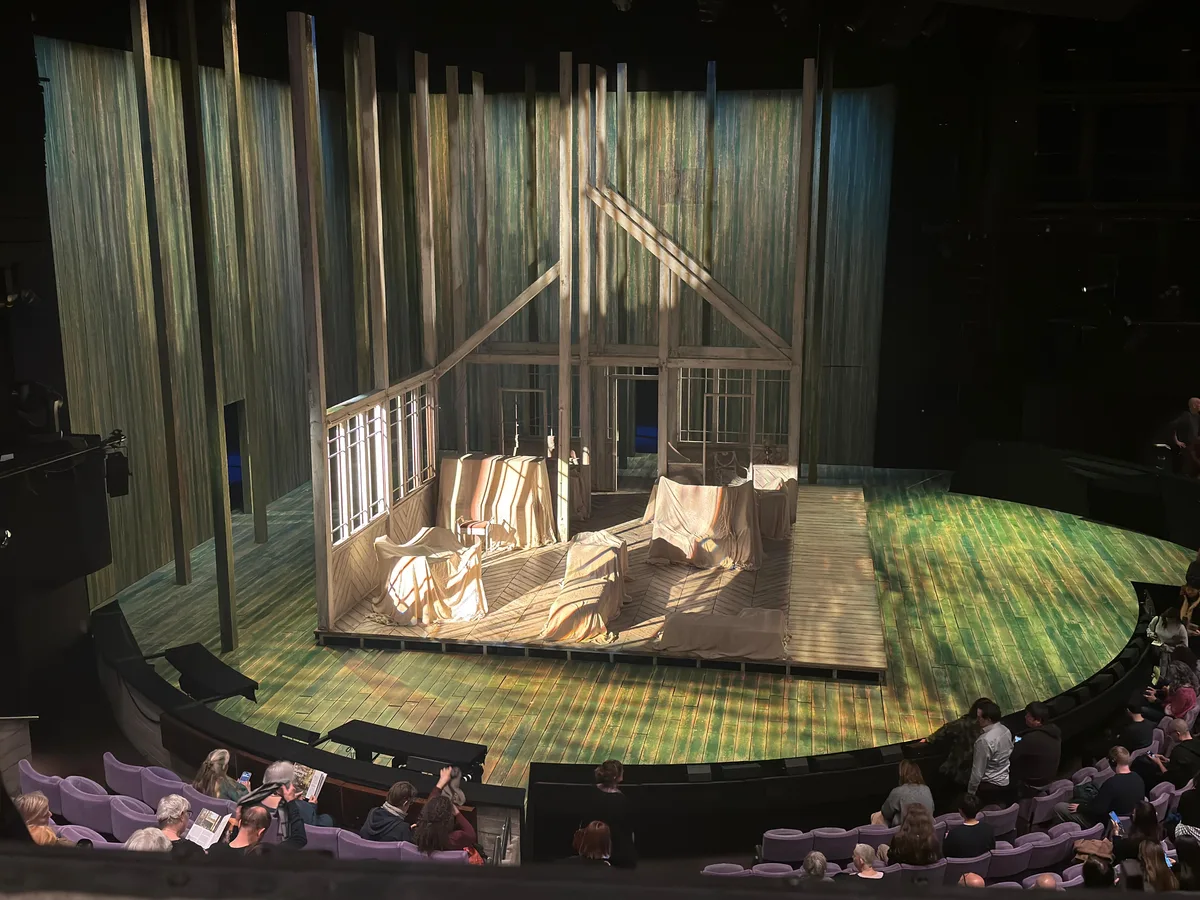
Summerfolk
- Playwright
- Maxim Gorky
- Adaptation
- Nina Raine & Moses Raine
- Director
- Robert Hastie
- Design
- Peter McKintosh
- Cast
- Sophie Rundle, Paul Ready, Alex Lawther, Daniel Lapaine, Doon Mackichan
- Ticket
- £39
- Seat
- Circle, Row A, Seat 70
Summerfolk gets a 4/5. This is my subjective, unqualified, unapologetically biased take on what I saw.
Summerfolk is showing at the National Theatre until 29 April 2026.